What Is Chromium Flake and How Does It Differ From Chromium Powder
Elemental chromium is commercially available in multiple physical forms, and the form matters as much as the purity. Chromium flake and chromium powder are both CAS 7440-47-3 (the same element with the same chemistry), but their physical geometries, surface area characteristics, and processing behaviors differ in ways that directly affect downstream process efficiency.
Choosing between them is rarely about purity alone. Melting charge additions, powder metallurgy, thermal spray, and additive manufacturing each impose different feedstock specifications, and matching the material form to the process determines whether the material performs as intended.
This post compares chromium flake and chromium powder across production methods, physical properties, and downstream application suitability, providing engineers and procurement teams with a technical basis for selecting material form.
How Chromium Flake Is Produced
Chromium flake is produced through electrolytic refining. Through that process, chromium is dissolved from an anode and deposited onto a cathode inside an electrolytic cell. The deposit morphology is controlled by operating conditions, typically approximately 1 V and near 100 A, according to Bureau of Mines electrorefining data. The resulting deposit is separated to yield thin, plate-like particles with a high aspect ratio.
That geometry is significant. Compared to equiaxed or spherical powder particles of equivalent mass, flakes exhibit a higher surface area per unit mass, which affects dissolution kinetics, oxidation exposure, and interactions with the surrounding melt chemistry.
Purity and Traceability in Flake Production
Electrolytic chromium flake is available at purity levels of 99.8% and above. Degassed grades can reach 99.95% Cr or higher, with controlled limits on carbon, sulfur, oxygen, nitrogen, and iron, the impurities most critical to superalloy and vacuum-melt applications.
For example, CR-115, Atlantic Equipment Engineers’ stocked chromium flake, is supplied at 99.8% purity in a 1″ x Downsize format.
How Chromium Powder Is Produced and Characterized
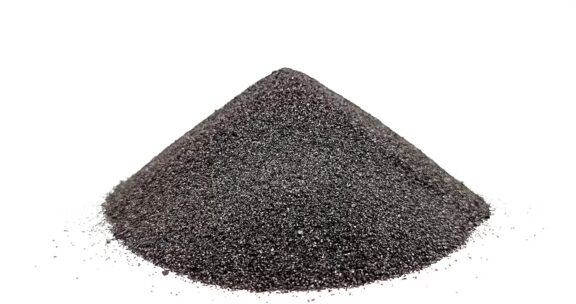
Chromium powder is produced by several distinct routes, each yielding a different particle morphology.
- Aluminothermic reduction produces angular, irregular particles with characteristics that limit green strength in powder metallurgy applications, according to U.S. Patent 20160199910.
- Reduction of Cr₂O₃ in molten calcium chloride salt yields cubic crystallites, as reported in Metallurgical and Materials Transactions B (2004).
- Gas atomization and the Plasma Rotating Electrode Process (PREP) produce spherical particles optimized for flowability, the morphology preferred in thermal spray and additive manufacturing feedstocks.
Key characterization parameters include particle size distribution (expressed in mesh or microns), morphology, apparent density, flowability, and oxygen content, each of which affects downstream performance differently depending on the process. The production route directly determines particle geometry, which in turn governs packing density, sinterability, coating adhesion, and feedstock flow in AM and thermal spray systems.
Controlled Particle Size and Its Role in Powder Applications
Tight particle size distributions improve lot-to-lot consistency in sintering, pressing, and coating operations. Deviation from the specified size range affects green density in powder metallurgy and deposition efficiency in thermal spray. For application-specific requirements, custom particle size distributions are available from specialty suppliers like Atlantic Equipment Engineers
Key Differences Between Chromium Flake and Chromium Powder
The selection criteria between chromium flake and chromium powder are purely physical, as both forms share the same elemental composition.
Morphology and surface area. Flake has a thin, platelet geometry with a high aspect ratio. Powder morphology varies from angular to spherical depending on the production route. The platelet shape gives flake a higher surface-area-to-volume ratio than coarse or equiaxed powder of equivalent size, which contributes to faster dissolution in melting applications.
Bulk density and flow behavior. Spherical powder packs more densely and flows predictably through automated feeders and hoppers. Flake has a lower apparent density, and its platelets can interlock. While this is not a concern for manual additions to a furnace charge, it should be accounted for in the design of automated feeding systems.
Dissolution and melting behavior. The thin geometry of the flake promotes faster, more uniform dissolution when charged into induction or arc furnaces compared to coarser chromium forms. This characteristic makes it practical for alloy melt additions where uniform chromium distribution is required.
Handling considerations. Fine chromium powder, particularly the sub-45 µm fractions, requires controlled handling due to dust generation and susceptibility to surface oxidation. Flake, at typical charge-addition sizes, is generally more manageable at an industrial scale.
When to Choose Chromium Flake
Chromium serves as a critical alloying element across a wide range of metal systems. As documented in Britannica’s analysis of chromium processing, it is essential for stainless steels (10–26% Cr), low-alloy steels (up to 2%), nickel-chromium superalloys (up to 60%), and cobalt alloys (up to 25%), as well as custom alloys tailored to strict engineering standards. For these melt applications, the high surface area and thin-platelet geometry of flake chromium enable faster, more uniform dissolution during furnace charge additions than bulkier forms.
This rapid dissolution behavior is particularly valuable in vacuum melting for superalloys, such as those used in jet engine turbine blades and gas turbine components. These demanding applications require degassed electrolytic chromium in flake or compact form to maintain tight control over nitrogen, oxygen, and sulfur levels, as excessive impurities can compromise the structural integrity of cast parts.
Ultimately, electrolytic chromium flake provides purity levels on par with high-purity powders, reaching 99.95% or higher in degassed grades, while offering a manageable physical form that avoids the industrial dust and rapid oxidation risks typical of fine powders.
When to Choose Chromium Powder
Powder metallurgy, pressing, and sintering
Controlled particle size and morphology are essential for achieving the target green density and sintered properties. Angular and sponge-form powder grades produced by reduction routes are used in powder metallurgy for structural and wear-resistant components, where compressibility and sintered density depend directly on morphology and particle size distribution.
Thermal spray coatings
Specific particle-size ranges, typically 15-150 µm depending on the spray process, are required for consistent feedstock flow and deposition efficiency. Spherical morphology improves flow rate and coating uniformity relative to angular alternatives.
Additive manufacturing feedstocks
Spherical morphology and a tight particle-size distribution are process requirements for powder bed fusion and directed energy deposition. Angular or irregular powder causes inconsistent layer deposition and affects part density.
Laboratory-scale work and R&D
Chromium powder enables precise weighing and blending in small quantities, making it a practical choice for experimental alloy development, process development, and materials testing.
Chromium Form Selection: Matching Material to Process
Chromium flake and chromium powder are both high-purity elemental chromium. The selection criteria are physical and include morphology, particle size, surface area, and impurity profile to determine which form is correct for a given process.
Chromium flake is the preferred form when fast, uniform dissolution in a melt is the priority and the controlled impurity profile of degassed grades is required for high-performance alloy and superalloy production. Conversely, chromium powder is the preferred form where particle size distribution, morphology, and flowability govern process performance, such as in sintering, thermal spray, and additive manufacturing.
Both forms are available from Atlantic Equipment Engineers with documented purity, full lot traceability, and fast shipping to keep production schedules on track.
Working With Atlantic Equipment Engineers on Chromium Form Selection
Atlantic Equipment Engineers supplies chromium in both flake and powder forms. CR-115 (chromium flake, 99.8% purity, 1″ x Downsize) is stocked and available for same-day or overnight shipment.
Furthermore, the full range of chromium powder grades available from Atlantic Equipment Engineers spans multiple particle size ranges and morphologies to support powder metallurgy, thermal spray, additive manufacturing, and laboratory applications.
Custom alloy specifications can be accommodated to meet application-specific requirements, including controlled particle-size distributions not available from standard inventory.
Engineers and procurement teams can contact Atlantic Equipment Engineers to discuss chromium form selection based on their specific process parameters.

Other Articles by
-
How Metal Reduction Processes Use Iron Powder as a Chemical Reducing Agent
-
Metal Powders and the World of Bullets and Fireworks
-
Comparing Atomized vs. Mechanically Processed Powder Metals
-
Zone Refined Silicon Pieces Serve Demanding Electronics Applications