What Is the Difference Between Titanium Sponge and Titanium Powder?
Titanium sponge is the porous, irregular metal produced directly by primary titanium reduction, while titanium powder is titanium processed into controlled particle sizes and shapes for downstream manufacturing. The difference between titanium sponge and titanium powder lies mainly in morphology, particle size control, and intended use rather than in purity, because powder is frequently produced from sponge in the first place. Understanding that relationship is the key to specifying the right form for a given process.
The two are not always distinct materials. Sponge is the starting point for much titanium powder, so the meaningful comparison is not which one is purer but which one best fits the process at hand. This post covers how each form is produced, how its particle characteristics differ, and which industries and processes favor one over the other.
How Titanium Sponge Is Produced
Titanium sponge is the first metallic form of titanium produced from ore-derived feedstock, and its structure explains why it behaves the way it does. According to research on the Kroll process, titanium tetrachloride is reduced with molten magnesium to yield metallic titanium as a porous, spongy mass, which is where the material gets its name. The reduction leaves behind a structure full of voids rather than a dense, uniform solid.
That porosity is more than a visual trait. The open structure gives sponge a high internal surface area, which makes it prone to absorbing oxygen, nitrogen, and hydrogen from the surrounding environment. For this reason, sponge is handled and melted under a controlled atmosphere to protect its interstitial chemistry. The irregular, coarse form is a direct result of how the metal first forms during reduction.
In most applications, sponge is an intermediate feedstock rather than an end product. It is typically remelted into an ingot for wrought processing or converted into powder before it reaches a finished part. This upstream position is what sets up the rest of the comparison, since the powder a manufacturer specifies often began as sponge.
How Titanium Powder Differs in Form and Production
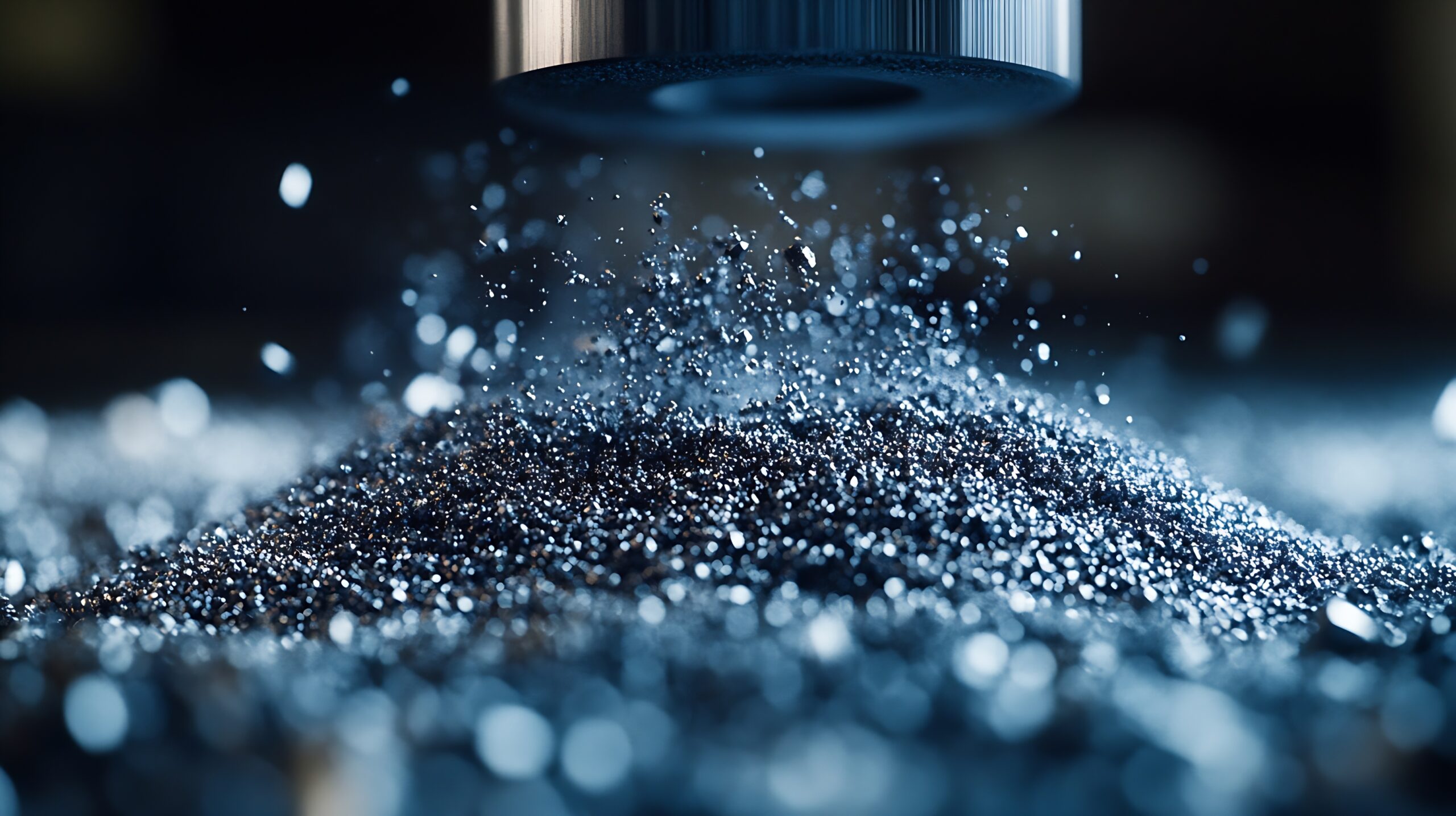
Titanium powder is titanium processed into discrete particles with controlled size and shape, and the production route determines much of its character. Two routes dominate, producing powders with very different morphologies.
- The hydride-dehydride (HDH) process converts titanium feedstock, such as sponge, into angular, irregular powder by hydrogenating the metal to make it brittle, milling it, and then removing the hydrogen.
- Gas atomization melts consolidated titanium and breaks the molten stream into droplets that solidify into spherical powder.
According to studies on the use of non-spherical HDH powder in powder bed fusion additive manufacturing, the chosen route affects not only particle shape but also characteristics such as oxygen content. That distinction matters in practice. Powder is selected for how well it fits a process, not because it represents a purer version of the sponge it came from. A spherical atomized grade and an angular HDH grade of the same alloy serve different processes despite sharing the same chemistry.
The catalog at Atlantic Equipment Engineers reflects this range with controlled-morphology offerings. These include commercially pure titanium powder at minus 100 mesh and 99.7 percent purity, Ti-6Al-4V spherical powder at 15 to 45 microns, and Ti-6Al-4V irregular powder at minus 325 mesh. Each grade pairs a specific morphology and size range with the processes it is built to serve.
Particle Shape, Size, and Processability
Shape and size govern how a powder behaves on the production floor. Spherical atomized powder flows and packs more predictably than angular or irregular powder, which is why it dominates processes that depend on uniform spreading and consistent density. Angular powder can still perform well where flowability is less critical and cost or availability favors the HDH route.
Size carries its own consequences. Finer particles have a higher specific surface area, which increases oxidation and ignition sensitivity, so fine titanium powder requires careful handling and storage that coarse sponge does not. The same surface area that makes fine powder reactive also makes it sinter and react efficiently under the right process conditions.
Above all, repeatability is what separates engineered powder from raw sponge. Controlled, consistent particle characteristics make powder suitable for processes that depend on predictable behavior batch after batch, whereas raw sponge would not perform reliably in those settings.
Mesh Sizing and Particle Distribution
Mesh sizing and particle size distribution are the measurable specifications that turn the sponge-versus-powder discussion into something a buyer can actually order against. Mesh designations describe the screen openings a material passes through, and particle size distribution describes the spread of sizes within a given lot. Powder is engineered to tighter tolerances than sponge, which is part of what makes it suitable for precision processes.
Atlantic Equipment Engineers’ own catalog serves as a useful bridge between the two extremes. Its titanium sponge powder at minus 50 plus 100 mesh ships as titanium sponge granules, a coarse crushed-sponge product that sits between primary sponge and fine engineered powder. It describes their titanium range as spanning roughly greater than 20 microns up to sponge and ingot, which shows that the distinction is a spectrum of forms rather than a hard line between two categories.
Distribution drives suitability across processes. In powder metallurgy, consistent packing and predictable sintering depend on controlled size ranges. In thermal spray and alloying, particle size affects deposition behavior, melt response, and the final homogeneity of the coating or alloy. A material that works for one of these processes can be wrong for another purely on the basis of its size distribution.
Material Selection Across Industries and Processes
Once the technical differences are clear, the procurement question becomes practical. Coarse sponge and sponge granules are generally preferred where the titanium will be melted or consumed in bulk rather than shaped directly. Common uses include feedstock for ingot and alloy melting, foundry operations, pyrotechnics, and titanium additions in steel and specialty alloy production.
Engineered powder is preferred when the process builds up or coats a part directly from particles. Typical applications include the following:
- Powder metallurgy components that rely on consistent packing and sintering
- Thermal spray coatings where particle size governs deposition
- Additive manufacturing, along with aerospace, medical, and defense parts that demand controlled feedstock
The choice between forms comes down to purity requirements, particle specifications, and process compatibility. A foundry melting titanium to form an alloy does not require atomized spherical powder, and an additive manufacturing system cannot run on coarse sponge granules. Matching the form to the process is the core of specifying titanium correctly.
Sourcing Titanium in the Right Form
The practical difference between titanium sponge and titanium powder comes down to three things. Production route determines how the material forms, morphology determines how it behaves during processing, and particle characteristics determine which processes it suits. Purity, while important, is rarely the dividing line, since powder is so often made from sponge.
For any titanium specification, controlled particle size, verified purity, and lot consistency are what keep a process predictable from one order to the next. These are the variables that separate a material that performs from one that introduces risk.
Atlantic Equipment Engineers supplies high-purity titanium across a range of forms and particle sizes, from coarse sponge and granules through fine commercially pure and alloy powders, backed by ISO 9001-certified processes, full traceability, and lot control. Contact Atlantic Equipment Engineers to discuss your titanium material requirements and the form that best suits your process.

Other Articles by
-
Why 1-5 Micron APS Tantalum Powder Is the Standard for Medical Device Manufacturing

-
How Metal Reduction Processes Use Iron Powder as a Chemical Reducing Agent
-
How Does Manganese Powder Influence Hardness and Wear Resistance in Alloys?
-
Comparing Atomized vs. Mechanically Processed Powder Metals