Zone Refined Silicon Pieces Serve Demanding Electronics Applications
Semiconductor and microelectronics processes tolerate almost no trace contamination. A few parts per million of an unwanted metal or dopant can shift a material’s resistivity, alter carrier behavior in a device, or introduce defects that only appear after a component is in service.
Silicon’s usefulness in these processes stems from the predictable way its electrical properties respond to controlled doping, which is also why any uncontrolled impurity is a liability rather than a minor variable. Standard commercial silicon, adequate for many industrial uses, does not meet that threshold.
Zone-refined silicon pieces at 99.999% purity, often called five-nines silicon, are specified when contamination limits fall below what conventional refining can deliver. This grade is produced through a controlled purification process that targets specific classes of impurities, and it is supplied in solid form, suitable for melting, evaporation, and deposition work.
The sections below cover what zone refining removes and why one common impurity resists it, where standard silicon grades stop being adequate, why the piece form fits real-world production workflows, and how the material feeds into sputtering targets and other microelectronics manufacturing processes.
How Zone Refining Purifies Silicon
Zone refining, also called zone melting, purifies a silicon rod by passing a narrow molten band slowly along its length. According to Britannica, impurities in the rod tend to remain in the molten zone rather than rejoining the solid that recrystallizes behind it, so as the zone travels, it carries a portion of the impurity load with it toward one end of the bar.
How strongly a given impurity behaves this way is described by its segregation coefficient, also called the distribution coefficient. According to Chemistry LibreTexts, the equilibrium coefficient, written as k0, is defined as Cs/Cl, the ratio of an impurity’s concentration in the solid to its concentration in the liquid at the melt interface.
When k0 falls below 1, the impurity is rejected into the liquid as the zone advances, so the silicon that refreezes at the trailing edge of the molten zone comes out purer than the material still melting in at the leading edge just ahead of it. Each pass shifts another increment of the impurity load toward one end of the rod, and cropping that end away after every pass is what the same source credits with allowing purification to reach exceptionally high levels.
Applied repeatedly, that step-by-step reduction is how the process reaches purity levels of 99.999% and beyond. Britannica adds that this mechanism, applied to germanium, has been pushed as far as one detectable impurity atom per 10 billion, an indication of how much headroom repeated zone passes leave for driving a material toward its practical purity limit.
Which Impurities Are Removed and Why Boron Resists
Not every impurity responds to zone refining the same way. Metallic contaminants tend to have very low segregation coefficients, which means they partition almost entirely into the melt. According to Chemistry LibreTexts, iron has a segregation coefficient near 8×10⁻⁶ and copper near 4×10⁻⁶, while aluminum sits near 0.002. All three segregate strongly from the solid, and the same source identifies iron and aluminum as the dominant contaminants in as-produced metallurgical-grade silicon.
Boron is the exception worth flagging. Its segregation coefficient runs near 0.8, close enough to 1 that it partitions only slightly into the liquid zone, so repeated passes remove far less of it than they remove of iron, copper, or aluminum. Because boron also acts as a dopant that changes silicon’s electrical behavior even at low concentrations, controlling it is a specific concern for anyone specifying electronic-grade material rather than a general footnote about purity.
The metallic impurities are worth removing for a specific electrical reason. PVEducation describes how transition metals in silicon create deep levels within the material’s bandgap, and the resulting recombination activity is high enough to make untreated metallurgical-grade silicon unsuitable for electronic use.
Therefore, zone refining earns its place in the production chain by clearing out the metallic species responsible for that effect, and that reduction is what separates electronic-grade silicon from standard commercial stock.
When Standard Silicon Grades Fall Short
Metallurgical-grade silicon, the form used across much of heavy industry, runs at roughly 98% purity. According to PVEducation, it still carries boron, phosphorus, and metallic impurities at concentrations far too high for electronic use, which keeps it well-suited to alloying and as a chemical feedstock, but ineffective anywhere current has to move through the material in a controlled way.
Past a certain purity threshold, residual impurities start to change resistivity and, in turn, device performance, so 99.999% purity functions as a specification rather than a preference. That relationship is direct because resistivity in silicon depends on dopant and impurity concentrations, so an uncontrolled metallic or boron background shifts the electrical baseline around which a process was designed, and that shift is difficult to correct downstream once a wafer or film is already formed.
An engineer weighing which grade to order can use the intended process as the deciding factor. When the end use involves active devices, thin films, or any deposition step, standard-grade silicon introduces a contamination risk that zone-refined silicon pieces are built to remove. When the end use is alloying, a chemical feedstock role, or another application where electrical behavior is not the concern, metallurgical-grade material remains the appropriate and more economical choice.
Why the Piece Form Suits Melting and Deposition Processes
The physical form of the material matters as much as its purity for how it performs in production. Random-sized pieces charge cleanly into a crucible for remelting or crystal growth, packing efficiently and reducing handling steps compared with material that requires pre-sizing.
Solid pieces also work directly as evaporation and deposition source material, presenting a consistent, high-purity charge with no binders or additives to burn off or contaminate the process. That matters in vacuum deposition specifically, where any additive or coating on the source material can outgas or deposit alongside the silicon itself and compromise the resulting film.
On the practical side, pieces are straightforward to weigh out to a target charge mass, which supports repeatable melts run after run. They also store without the surface-area exposure that comes with powders, an advantage for both contamination control and basic handling safety on the production floor.
From Zone Refined Pieces to Sputtering Targets and Microelectronics
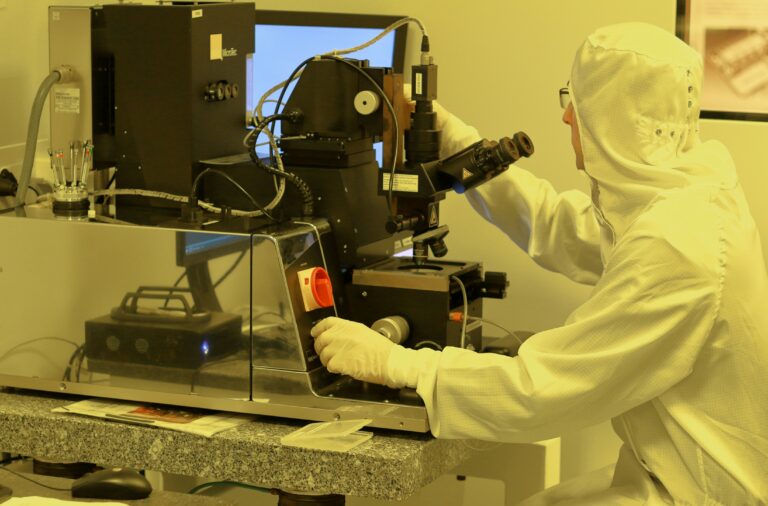
High-purity silicon pieces feed directly into the fabrication of sputtering targets, which deposit thin silicon films during semiconductor manufacturing.
Producing a target from material with a known, controlled impurity profile enables the resulting film to maintain consistent electrical and structural properties across a production run. That same purity carries into microelectronics assembly, where the material is used as an epoxy filler in applications where any contamination risks could compromise a sensitive component.
The purity and consistency that make zone-refined silicon suitable for these uses extend into a few adjacent industries as well, including ceramic bearings, cutting tools and pyrotechnic mixtures.
The range of these applications, spanning precision electronics manufacturing on one end and industrial and specialty formulations on the other, illustrates how the same underlying grade supports very different production needs once purity and form are controlled.
It is also why the same material moves across customers in electronics, aerospace, defense, medical device manufacturing, energy storage, and research and development, each specifying it for a different process but relying on the same purity floor.
Where to Order Zone Refined Silicon Pieces with Consistent, Traceable Supply
Atlantic Equipment Engineers supplies 99.999% zone-refined silicon pieces in quantities that range from small laboratory orders to industrial volumes, with stock available for immediate shipment.
ISO 9001 certification backs the company’s quality management system, ensuring full lot traceability and documentation with every shipment. This enables engineers to confidently verify purity and batch-to-batch consistency across recurring orders.
With verified documentation, production lines bound by stringent purity criteria can integrate new lots immediately without needing to repeat the material qualification process.
That combination of verified purity, documented process control, and ready stock is what makes zone-refined silicon pieces practical to specify for electronics and other high-purity applications without introducing supply risk into the process.
Contact Atlantic Equipment Engineers to discuss material requirements for zone-refined silicon pieces.

Other Articles by
-
How Metal Reduction Processes Use Iron Powder as a Chemical Reducing Agent
-
How Does Manganese Powder Influence Hardness and Wear Resistance in Alloys?
-
Metal Powders and the World of Bullets and Fireworks
-
Comparing Atomized vs. Mechanically Processed Powder Metals